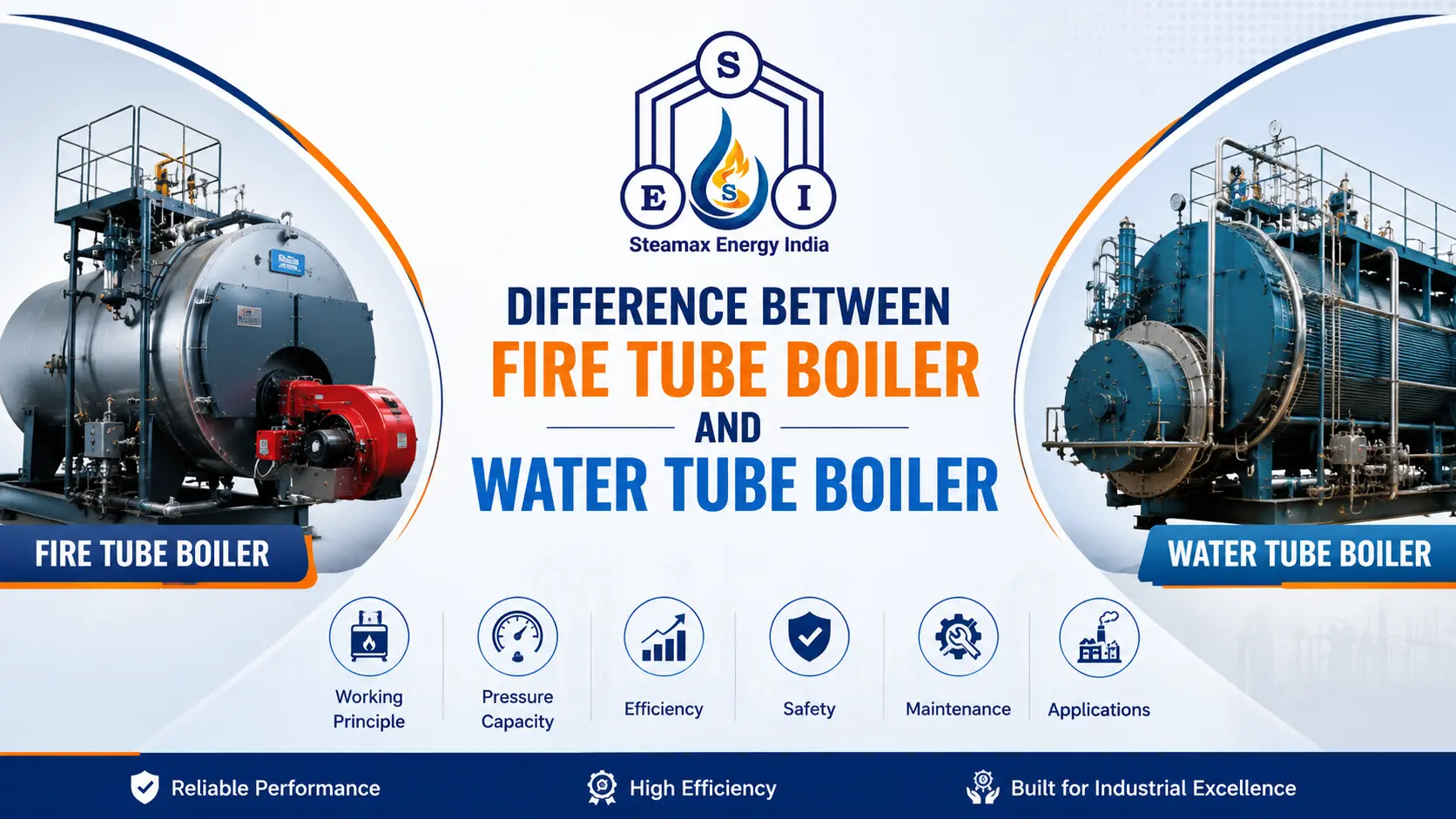
Choosing the right boiler is one of the most important decisions for any industry that relies on steam for production. Whether you operate a food processing plant, textile unit, pharmaceutical facility, chemical factory, paper mill, or rice mill, selecting the appropriate boiler can directly impact fuel consumption, operating costs, safety, and overall productivity.
Among the different types of industrial boilers, fire tube boiler and water tube boiler are the two most commonly used options. While both are designed to generate steam, they differ significantly in their construction, working principle, steam generation capacity, pressure range, efficiency, and applications.
Many people assume that both boilers perform the same function, but understanding the difference between fire tube and water tube boiler is essential before making an investment. Each boiler has its own advantages and limitations, making it suitable for different industrial applications.
In this comprehensive guide, we’ll explain the construction, working principle, advantages, disadvantages, applications, and the key difference between fire tube boiler and water tube boiler to help you choose the right solution for your business.
What is a Fire Tube Boiler?
A fire tube boiler is a type of boiler in which hot combustion gases flow through tubes, while water surrounds these tubes inside the boiler shell. As the hot gases travel through the tubes, heat is transferred to the surrounding water, producing steam.
Fire tube boilers are widely used in industries where low to medium steam pressure is required. Their simple design, easy operation, and lower installation cost make them a popular choice for small and medium-sized industries.
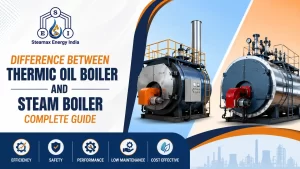
Also Read: Difference Between Thermal Oil Boiler and Steam Boiler: Complete Guide
Working Principle of a Fire Tube Boiler
The burner produces heat by burning fuel such as diesel, furnace oil, natural gas, LPG, biomass, or other fuels. The hot flue gases pass through multiple fire tubes immersed in water. Heat from these gases is transferred to the water, causing it to boil and generate steam.
The generated steam is then collected in the upper portion of the boiler and supplied to various industrial processes.
What is a Water Tube Boiler?
A water tube boiler works on the opposite principle. Instead of hot gases flowing through tubes, water flows inside the tubes while hot combustion gases circulate around them.
This design allows faster heat transfer, higher steam generation, and operation at much higher pressures compared to fire tube boilers.
Water tube boilers are commonly installed in power plants and large industrial facilities where continuous steam production and high-pressure operation are essential.
Working Principle of a Water Tube Boiler
Water is pumped into a network of tubes positioned inside the boiler. The burner heats the outside of these tubes, rapidly converting the water into steam. The steam then moves to a steam drum, where it is separated and supplied to the plant.
Because only a small quantity of water remains inside the tubes at any given time, the boiler responds quickly to changing steam demand.
Difference Between Fire Tube and Water Tube Boiler
The following table explains the major difference between fire tube and water tube boiler.
| Parameter | Fire Tube Boiler | Water Tube Boiler |
|---|---|---|
| Working Principle | Hot gases flow through tubes | Water flows through tubes |
| Water Location | Around the tubes | Inside the tubes |
| Steam Pressure | Low to Medium | Medium to Very High |
| Steam Generation | Moderate | Very High |
| Efficiency | Good | Higher |
| Heating Speed | Slower | Faster |
| Boiler Size | Compact | Larger |
| Initial Cost | Lower | Higher |
| Maintenance | Easier | More Technical |
| Safety | Suitable for low-pressure applications | Designed for high-pressure operation |
| Fuel Consumption | Moderate | Better efficiency for large plants |
| Best For | Small & Medium Industries | Large Industrial Plants & Power Stations |
This comparison clearly highlights the difference between fire tube boiler and water tube boiler and why industries choose different boiler types based on their steam requirements.
Fire Tube Boiler Advantages
Fire tube boilers continue to be one of the most widely used industrial boilers because of their simple construction and reliable operation.
Some of their major advantages include:
- Lower installation cost
- Easy to operate
- Simple maintenance
- Compact design
- Reliable steam generation
- Suitable for small and medium industries
- Lower initial investment
- Easy availability of spare parts
- Long operational life
- Quick installation
These benefits make fire tube boilers an excellent option for industries with moderate steam demand.
Water Tube Boiler Advantages
Water tube boilers are designed for industries requiring continuous, high-capacity steam production.
Major advantages include:
- High steam generation capacity
- High operating pressure
- Better thermal efficiency
- Faster steam production
- Lower risk of shell failure
- Suitable for continuous operation
- Excellent heat transfer
- Fuel-efficient performance
- Suitable for automation
- Ideal for large industrial applications
Their ability to operate efficiently under demanding conditions makes them the preferred choice for heavy industries.
Fire Tube Boiler vs Water Tube Boiler: Which One is Better?
There is no single answer because the right boiler depends on your industrial requirements.
If your factory requires moderate steam pressure with lower investment and easier maintenance, a fire tube boiler is generally the better option.
However, if your plant requires high-pressure steam, continuous production, and maximum efficiency, a water tube boiler is the ideal solution.
When comparing water tube boiler and fire tube boiler, factors such as production capacity, available space, operating pressure, fuel type, maintenance requirements, and long-term operating costs should always be considered before making a decision.
Applications of Fire Tube Boilers
Fire tube boilers are commonly used in:
- Food Processing Plants
- Rice Mills
- Dairy Industries
- Textile Units
- Breweries
- Hotels
- Hospitals
- Pharmaceutical Industries
- Chemical Processing Plants
- Small Manufacturing Units
Applications of Water Tube Boilers
Water tube boilers are widely used in:
- Thermal Power Plants
- Sugar Mills
- Petrochemical Industries
- Fertilizer Plants
- Oil Refineries
- Steel Plants
- Paper Mills
- Chemical Industries
- Large Food Processing Plants
- Heavy Manufacturing Industries
Factors to Consider Before Choosing a Boiler
Before purchasing a boiler, industries should evaluate several important factors.
Steam Requirement
Determine how much steam your production process requires every hour.
Operating Pressure
Choose a boiler capable of safely handling your required steam pressure.
Fuel Availability
Select a boiler compatible with the fuel that is easily available and economical for your plant.
Energy Efficiency
An energy-efficient boiler reduces fuel consumption and lowers operating costs over time.
Maintenance Requirements
Consider the availability of skilled operators, maintenance support, and spare parts.
Future Expansion
Choose a boiler that can accommodate future production growth without requiring major modifications.
Why Choose Steamax Energy India?
At Steamax Energy India, we manufacture high-quality industrial boilers designed for reliable steam generation, fuel efficiency, and long-term performance. Our engineering team helps customers select the most suitable boiler based on their industry, steam requirement, fuel type, and production capacity.
Our strengths include:
- Customized boiler solutions
- Energy-efficient designs
- Premium-quality manufacturing
- Advanced safety features
- Robust construction
- Easy maintenance
- Competitive pricing
- Timely project delivery
- Installation & commissioning support
- Reliable after-sales service
Whether you need a fire tube boiler or another industrial steam solution, our experts ensure you receive equipment that delivers consistent performance and maximum operational efficiency.
Conclusion
Understanding the difference between fire tube boiler and water tube boiler is essential for selecting the right steam generation system. Although both boilers perform the same basic function, their construction, operating pressure, efficiency, and industrial applications differ significantly.
A fire tube boiler is ideal for industries requiring moderate steam output, lower installation costs, and easy maintenance. In contrast, a water tube boiler is designed for high-pressure, high-capacity applications where efficiency and continuous operation are critical.
Before making a purchase, carefully evaluate your production requirements, steam demand, operating pressure, and long-term operating costs. Consulting an experienced boiler manufacturer like Steamax Energy India can help you choose the most suitable solution that improves productivity, reduces fuel consumption, and ensures reliable performance for years to come.