Boilers play a vital role in industries that depend on steam for heating, power generation, and manufacturing processes. However, the performance and service life of a boiler depend not only on its design and fuel efficiency but also on the quality of water used to generate steam. Untreated water may contain dissolved minerals, suspended particles, dissolved gases, and other impurities that can cause scaling, corrosion, and reduced heat transfer.
Boiler feed water treatment is an essential process that prepares water to meet the specific requirements of a boiler system. It helps protect internal components, improve operational efficiency, and minimize maintenance costs. For industries using steam boilers, implementing an appropriate water treatment program is an important step toward safe and reliable operation.
In this guide, we will explain the importance, process, and benefits of boiler feed water treatment, along with the role of modern treatment equipment in industrial applications.
What Is Boiler Feed Water Treatment?
Boiler feed water treatment is the process of removing or controlling impurities in water before it enters a boiler. The treatment method depends on factors such as boiler pressure, feed water quality, steam purity requirements, and the type of industrial application.
Raw water may contain calcium, magnesium, silica, dissolved oxygen, carbon dioxide, and suspended solids. When this water enters a boiler without suitable treatment, these impurities can accumulate on heat transfer surfaces or react with metal components.
An effective boiler water treatment program generally combines external water treatment, internal chemical conditioning, and regular monitoring. Depending on the application, it may include filtration, softening, reverse osmosis, deaeration, chemical dosing, and blowdown control.
Also Read: How Do Modular Boilers Work? Complete Guide for Industries
Why Is Boiler Feed Water Treatment Important?
Proper water treatment helps maintain the efficiency, reliability, and safety of industrial boiler systems. Without adequate treatment, mineral deposits and corrosive substances can gradually damage equipment and increase operating expenses.
1. Prevents Scale Formation
Hard water contains calcium and magnesium salts that can form hard deposits on boiler tubes and heat transfer surfaces. These deposits act as an insulating layer, reducing heat transfer and increasing fuel consumption.
Water softening and other suitable treatment methods help control hardness and reduce the risk of scale formation.
2. Reduces Corrosion
Dissolved oxygen, carbon dioxide, and unsuitable water chemistry can contribute to corrosion in feed water lines, boiler tubes, and condensate return systems.
Appropriate deaeration, chemical conditioning, and pH control help minimize corrosion and protect metal surfaces from premature deterioration.
3. Improves Boiler Efficiency
Scale and sludge interfere with heat transfer, while poor water quality can increase blowdown requirements. Treating feed water helps maintain cleaner heat transfer surfaces and supports efficient steam generation.
4. Extends Equipment Service Life
Corrosion, deposits, and overheating can damage pressure-bearing components. A properly designed treatment program reduces these risks and helps extend the operating life of the boiler and its associated equipment.
5. Reduces Maintenance Costs
Regular treatment can lower the frequency of descaling, tube cleaning, repairs, and unplanned shutdowns. It also helps maintenance teams identify water quality problems before they cause serious equipment damage.
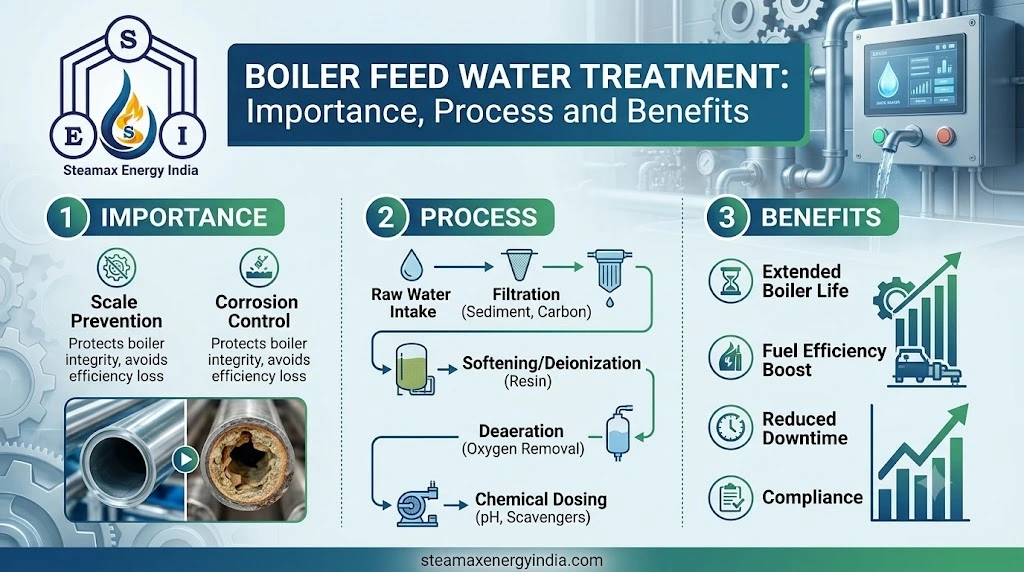
Boiler Feed Water Treatment Process
The exact water treatment of boiler systems varies according to the incoming water quality and boiler operating conditions. However, a typical industrial treatment process includes the following stages.
1. Raw Water Filtration
The first stage removes suspended particles such as sand, dirt, rust, and other solids. Multimedia filters or suitable cartridge filters may be used depending on the source water.
Effective filtration protects downstream equipment, including softeners, membranes, and other treatment components.
2. Water Softening
Water softeners commonly use ion-exchange resins to remove calcium and magnesium ions responsible for hardness. These ions are exchanged with sodium ions, reducing the potential for hardness-related scale formation.
For many boiler systems, softening is an important treatment stage. However, high-pressure boilers and applications requiring very low dissolved solids may need additional purification.
3. Reverse Osmosis and Demineralization
Depending on the boiler pressure and required water purity, reverse osmosis (RO) or demineralization may be necessary.
Reverse osmosis membranes reduce many dissolved salts and other impurities. Demineralization systems, such as ion-exchange units, remove additional dissolved ions to achieve the required water quality.
The selection of treatment technology should be based on water analysis and the boiler manufacturer’s specifications.
4. Deaeration
Dissolved oxygen and carbon dioxide can cause corrosion in boiler feed water systems. A deaerator removes much of these gases through controlled heating and gas separation.
Where required, suitable oxygen-scavenging chemicals may provide additional protection. Their use and dosage should follow the treatment program and applicable boiler operating guidelines.
5. Chemical Dosing and Conditioning
Chemical conditioning helps control residual hardness, pH, corrosion, and deposit formation. The chemicals used depend on the boiler design, operating pressure, water chemistry, and steam application.
A boiler chemical feed system is commonly used to deliver treatment chemicals in controlled quantities. It may include chemical storage tanks, dosing pumps, injection points, and control or monitoring equipment.
Accurate dosing is important because insufficient treatment may leave the system vulnerable to corrosion or deposits, while excessive dosing can create other water chemistry problems.
6. Boiler Blowdown
During steam generation, dissolved solids and treatment residues can become concentrated in boiler water. Blowdown removes a portion of this concentrated water and helps maintain acceptable water chemistry.
Surface blowdown may control dissolved solids, while bottom blowdown can help remove settled sludge. Proper blowdown management balances water quality requirements with energy and water conservation.
7. Water Quality Monitoring
Regular monitoring verifies that the treatment process is working as intended. Common parameters include hardness, pH, conductivity, dissolved oxygen, and alkalinity. Other tests may be required depending on the boiler and treatment program.
Monitoring results help operators adjust chemical dosing, blowdown rates, and treatment equipment settings when necessary.
Types of Boiler Water Treatment Methods
Different boilers require different treatment approaches. Common methods include:
- External Water Treatment: Filtration, softening, reverse osmosis, and demineralization remove impurities before water enters the boiler.
- Internal Chemical Treatment: Selected chemicals condition boiler water to control deposits and corrosion.
- Deaeration: Removes dissolved gases that can contribute to corrosion.
- Condensate Treatment: Helps protect condensate return lines and recover reusable water.
- Blowdown Management: Controls the concentration of dissolved solids inside the boiler.
A complete water treatment for boilers strategy often combines several of these methods rather than relying on a single process.
Key Benefits of an Effective Boiler Water Treatment System
Implementing a suitable treatment system offers several operational advantages.
- Better Heat Transfer: Reduced scale formation supports efficient heat exchange.
- Lower Fuel Consumption: Cleaner heat transfer surfaces can help prevent avoidable energy losses.
- Reduced Corrosion Risk: Proper chemical conditioning and gas removal protect system components.
- Fewer Unplanned Shutdowns: Preventive treatment reduces the likelihood of water-related failures.
- Improved Steam Quality: Appropriate control of dissolved solids helps reduce carryover risks.
- Optimized Water Usage: Effective blowdown control can reduce unnecessary water and energy losses.
- Longer Equipment Life: Reduced deposits and corrosion help protect the boiler and associated piping.
Actual savings depend on the initial water quality, boiler operating conditions, treatment design, and maintenance practices.
Common Boiler Feed Water Treatment Problems
Even a well-designed system may experience problems if equipment is poorly maintained or water chemistry is not monitored.
Scale formation: Check softener performance, hardness leakage, and the operation of upstream treatment equipment.
Corrosion: Review dissolved oxygen, pH, condensate quality, and chemical dosing records.
Excessive chemical consumption: Inspect dosing pumps, injection points, and chemical concentration settings.
High boiler water conductivity: Review feed water quality and blowdown control, and investigate possible contamination.
Frequent filter blockage: Examine raw water quality, filtration capacity, and the required cleaning or replacement schedule.
Corrective actions should be based on water analysis, operating data, and the boiler manufacturer’s recommendations.
Choosing the Right Boiler Feed Water Treatment System
Selecting the right system begins with understanding the incoming water quality and the boiler’s operating requirements. Industries should consider boiler pressure, steam production capacity, water consumption, condensate recovery, and the required purity of feed water.
A water analysis helps determine whether filtration, softening, reverse osmosis, demineralization, or additional treatment is needed. Chemical dosing equipment should also be selected according to the treatment chemicals, required dosing rate, and operating conditions.
Working with an experienced industrial boiler solutions provider can help businesses develop a treatment approach that supports reliable operation and long-term performance.
Why Choose Steamax Energy India?
Steamax Energy India serves industrial customers with boiler and thermal energy solutions designed around application requirements. For facilities operating steam boilers, effective feed water management is an important consideration alongside boiler selection, installation, and routine maintenance.
By understanding the relationship between water quality, heat transfer, and equipment reliability, industrial operators can make better decisions about their boiler systems. A suitable water treatment arrangement, combined with regular monitoring and preventive maintenance, helps support efficient and dependable steam generation.
Contact Steamax Energy India to discuss your industrial boiler requirements and identify suitable solutions for your facility.
Frequently Asked Questions
1. What is boiler feed water treatment?
Boiler feed water treatment is the process of removing or controlling impurities before water enters a boiler to minimize scale formation, corrosion, and other water-related operating problems.
2. Why is boiler water treatment necessary?
It helps protect boiler tubes, maintain heat transfer efficiency, reduce maintenance requirements, and support safe, reliable steam generation.
3. What chemicals are used in boiler water treatment?
Depending on the application, treatment may use oxygen scavengers, alkalinity or pH control chemicals, scale-control agents, and other approved conditioning chemicals. The selection and dosage depend on boiler pressure and water chemistry.
4. What is a boiler chemical feed system?
A boiler chemical feed system delivers treatment chemicals into designated parts of a boiler water circuit at controlled rates. It typically includes dosing pumps, chemical storage, and injection equipment.
5. Is water softening enough for every boiler?
No. Water softening reduces hardness, but some boilers require reverse osmosis, demineralization, deaeration, or additional conditioning to meet their feed water quality requirements.
Conclusion
Boiler feed water treatment is essential for maintaining boiler efficiency, controlling corrosion, preventing scale, and reducing avoidable maintenance costs. From filtration and softening to chemical dosing, deaeration, and blowdown, every treatment stage contributes to better control of boiler water quality.
For industrial facilities, the most effective approach is to select treatment methods based on water analysis, boiler operating conditions, and steam purity requirements. With appropriate equipment, regular monitoring, and a well-managed treatment program, businesses can improve operational reliability and support long-term boiler performance.