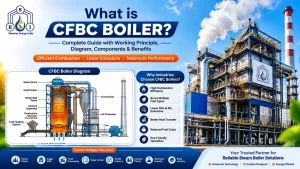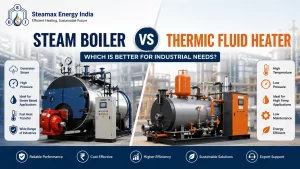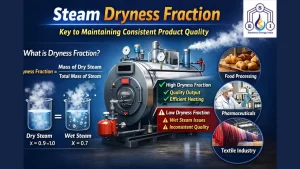
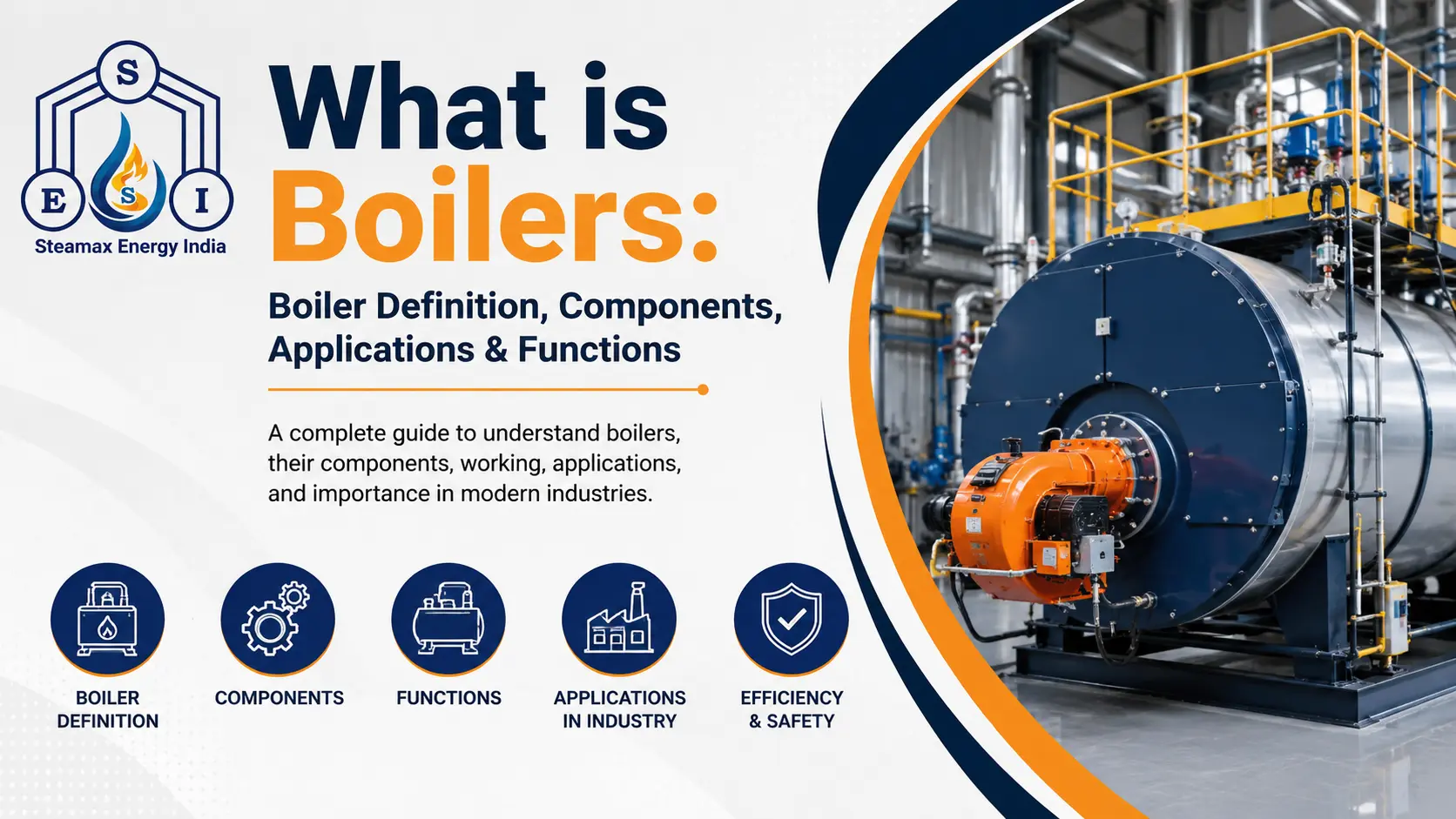
Boilers are the most critical equipment used in various industries to produce steam and hot water. Be it any factory, whether related to food processing, manufacturing, pharmaceuticals, or power generation, the role played by the boilers cannot be ignored. However, even though boilers are extensively utilized across different industries, it is not rare to see people asking the questions, ‘What is boiler? ‘ and ‘How do boilers work?’
In our upcoming blog posts, we will discuss all about boilers – their definition, parts/components, usage, and applications to make it easier for you to understand how vital they are in various industries.
What is Boiler?
A boiler is a closed vessel designed to heat water and convert it into steam using a heat source such as gas, diesel, oil, coal, biomass, or electricity. The generated steam or hot water is then used for heating, processing, power generation, sterilization, and various industrial operations.
Simply put, if someone asks what is boiler, it can be defined as a device that transfers heat energy to water to produce steam or hot water for practical use. The steam generated inside a boiler carries thermal energy that can be utilized in different industrial applications.
Also Read: How Boilers Are Used in Power Generation: Water and Steam
Boiler Definition in Mechanical Engineering
The boiler definition in mechanical engineering refers to a pressure vessel that converts water into steam by applying heat energy under controlled conditions. Mechanical engineers consider boilers as heat exchange systems where fuel energy is converted into thermal energy.
A boiler is designed to operate safely under pressure while delivering steam at the required temperature and pressure levels. Depending on the application, boilers may generate low-pressure, medium-pressure, or high-pressure steam.
The design, efficiency, and performance of a boiler depend on several engineering factors, including heat transfer rates, combustion efficiency, fuel type, and operating conditions.
Main Components of a Boiler
A boiler consists of multiple components that work together to generate steam efficiently. Understanding these parts helps in understanding the overall functioning of the system.
1. Boiler Shell
The boiler shell is the outer structure that contains water and steam. It is designed to withstand pressure and temperature variations during operation.
2. Burner
The burner mixes fuel and air to create combustion. It provides the heat required to convert water into steam.
3. Furnace
The furnace is the chamber where fuel combustion takes place. Heat generated in the furnace is transferred to the water inside the boiler.
4. Heat Exchanger
The heat exchanger allows efficient transfer of heat from combustion gases to water, improving the overall efficiency of the boiler.
5. Steam Drum
In many industrial boilers, the steam drum separates steam from water before supplying it to industrial processes.
6. Feed Water Pump
The feed water pump continuously supplies water into the boiler to maintain proper water levels and ensure uninterrupted steam production.
7. Safety Valve
The safety valve protects the boiler from excessive pressure by releasing steam when pressure exceeds safe operating limits.
8. Control System
Modern boilers are equipped with automated control systems that monitor temperature, pressure, fuel supply, and overall performance.
How Does a Boiler Work?
The working principle of a boiler is relatively simple. Fuel is burned inside the furnace to generate heat. This heat is transferred to the water stored inside the boiler. As the water absorbs heat, it reaches its boiling point and converts into steam.
The steam produced is collected and supplied through pipelines to different applications. Depending on the industrial requirement, steam can be used directly for heating, sterilization, drying, or power generation.
After releasing its energy, the condensed steam can often be recovered and reused, making the process more energy efficient.
Boiler in Industry: Why is it Important?
A boiler in industry serves as a vital utility system. Without a reliable boiler, many manufacturing and production processes would come to a halt.
Industries depend on boilers because they provide:
- Continuous steam supply
- Process heating
- Sterilization capability
- Energy-efficient operations
- Temperature control
- Reliable production support
Industrial boilers help improve productivity while ensuring consistent process quality.
Applications of Boilers
Boilers are used in a wide range of industries and commercial sectors.
- Pharmaceutical Industry- Steam is used for sterilization, cleaning, heating reactors, and maintaining hygienic conditions.
- Food Processing Industry- Boilers support cooking, drying, pasteurization, and food manufacturing operations.
- Textile Industry- Steam is used for dyeing, washing, finishing, and fabric processing.
- Chemical Industry- Chemical plants use steam for heating reactors and carrying out various chemical processes.
- Power Plants- Boilers generate high-pressure steam used to drive turbines for electricity generation.
- Hotels and Hospitals- Hot water and steam generated by boilers are used for laundry, cleaning, kitchen operations, and heating systems.
Functions of a Boiler
The primary function of a boiler is to convert water into steam or hot water. However, modern boilers perform several important functions, including:
- Generating steam for industrial processes
- Providing hot water for heating applications
- Supporting sterilization systems
- Supplying thermal energy for manufacturing
- Improving process efficiency
- Reducing operational downtime
- Supporting energy management systems
A properly selected boiler can significantly enhance productivity and operational performance.
Conclusion
Understanding what is boiler, its components, applications, and functions is essential for industries that depend on steam and hot water generation. According to the boiler definition in mechanical engineering, a boiler is a pressure vessel that converts water into steam through the application of heat energy. Today, a boiler in industry is indispensable for sectors such as pharmaceuticals, food processing, textiles, chemicals, and power generation.
At Steamax Energy India, we provide advanced and energy-efficient steam boiler solutions designed to meet the evolving requirements of modern industries. Whether you need a steam boiler, hot water boiler, or customized industrial heating solution, choosing the right boiler can improve efficiency, reduce operating costs, and ensure reliable performance for years to come.