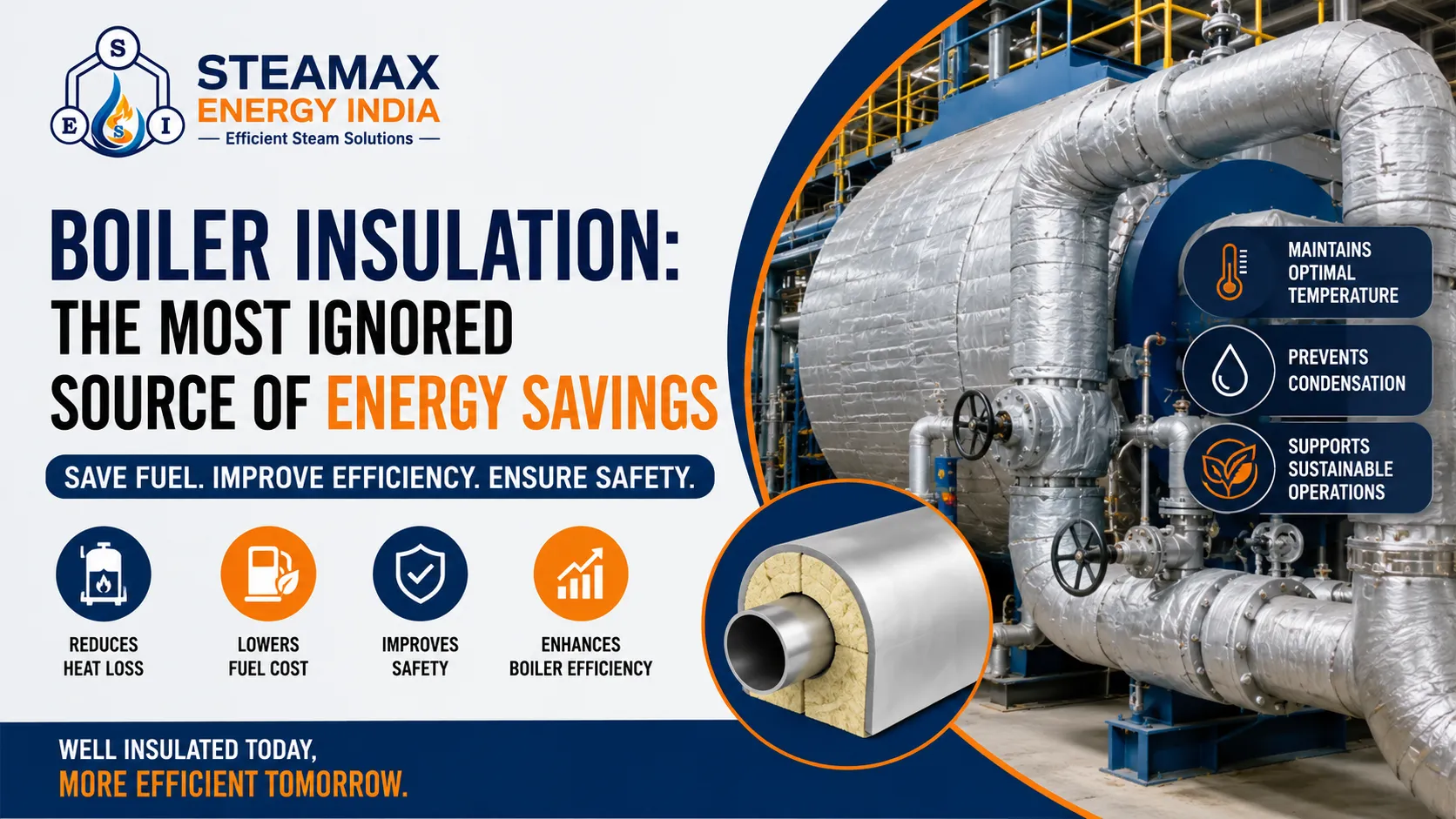
When industries look for ways to reduce boiler fuel consumption, they often focus on burners, combustion efficiency, steam pressure, or heat recovery equipment. However, one of the simplest areas is frequently overlooked: boiler insulation. A well-insulated boiler system can reduce unwanted heat loss, improve workplace safety, maintain stable operating temperatures, and support better overall energy efficiency.
Boilers operate at high temperatures, and their surfaces naturally release heat into the surrounding environment. If the boiler shell, steam pipes, valves, flanges, or other hot components are inadequately insulated, a significant amount of useful thermal energy can escape. This means the boiler may need to consume additional fuel to produce and maintain the required steam conditions.
For industries that operate boilers for long hours every day, improving insulation can therefore become a practical energy-saving measure. Steamax Energy India provides industrial boiler and thermal energy solutions, helping industries improve the performance and efficiency of their steam-generation systems.
What Is Boiler Insulation?
Boiler insulation is a protective thermal layer installed around hot boiler surfaces and associated components to reduce heat transfer from the equipment to the surrounding environment.
A boiler produces steam by transferring heat generated through fuel combustion to water. During this process, the boiler surface can reach high temperatures. Without sufficient insulation, heat naturally moves from the hot boiler surface toward the cooler surrounding air.
Insulation acts as a barrier that slows this heat transfer. It helps keep more of the generated thermal energy within the boiler system rather than allowing it to escape into the boiler room.
Boiler insulation can be applied to the boiler body, steam lines, hot-water lines, headers, ducts, valves, flanges, tanks, and other components depending on the system design and operating temperature.
Also Read: Air Preheater in Boiler: Working, Function & Types | APH
Why Is Boiler Insulation Important?
The main purpose of insulation is to reduce heat loss. However, its importance goes beyond saving energy.
When a boiler is poorly insulated, the surrounding boiler room can become excessively hot. This can create an uncomfortable working environment and may increase the demand on ventilation systems.
Good insulation helps maintain a more controlled environment around the boiler while reducing the temperature of accessible external surfaces. It can also help maintain more stable temperatures in steam and hot-fluid lines.
For a continuously operating industrial boiler, even relatively small heat losses occurring throughout the day can accumulate into substantial energy wastage over months and years.
How Does Boiler Insulation Save Energy?
The principle is straightforward. A hot boiler surface loses heat to its surroundings. The greater the temperature difference between the hot surface and surrounding air, the greater the potential for heat transfer.
Insulation adds thermal resistance between the hot equipment and the environment. This reduces the rate at which heat escapes.
While insulation itself does not create energy, it helps prevent useful thermal energy from being wasted. As a result, the boiler can retain more of the heat generated during combustion.
For example, if a boiler continuously loses heat through its shell and connected hot surfaces, the combustion system must continue supplying energy to compensate for those losses. Better insulation reduces this unnecessary heat requirement.
The actual energy savings depend on boiler size, surface temperature, insulation thickness, insulation material, operating hours, ambient conditions, and the condition of the existing insulation.
Which Parts of a Boiler Need Insulation?
Insulating only the main boiler body may not be enough. Heat can also escape from various connected components. Common areas that may require thermal insulation include the boiler shell, steam drum, headers, hot-water piping, steam pipelines, economizers, hot-air ducts, valves, flanges, tanks, and other high-temperature surfaces.
Valves and flanges can sometimes become overlooked because they have irregular shapes and are more difficult to insulate than straight pipe sections. However, these components can also contribute to heat loss. A proper insulation assessment should therefore consider the entire thermal system rather than focusing on one component.
Common Materials Used for Boiler Insulation
Different insulation materials can be selected depending on operating temperature, mechanical conditions, available space, moisture exposure, and application requirements.
Mineral wool is widely used in industrial thermal insulation because of its useful thermal resistance and suitability for many high-temperature applications. It can be used around boiler bodies, pipes, ducts, and other equipment when properly designed.
Ceramic fiber is another material used for high-temperature applications where excellent thermal resistance is required. It is often considered for areas exposed to particularly high temperatures.
Calcium silicate is also used in industrial insulation systems and is known for its rigid structure and ability to withstand elevated temperatures.
The correct material should be selected based on the actual temperature and operating conditions rather than simply choosing the material with the lowest initial cost.
Importance of Insulation Thickness
Choosing the right insulation thickness is just as important as choosing the insulation material. Very thin insulation may not provide adequate thermal resistance, while excessively thick insulation can increase installation cost without providing proportional benefits for a particular application.
The ideal thickness depends on operating temperature, insulation conductivity, ambient conditions, surface temperature requirements, and energy-saving objectives. Industrial insulation should therefore be designed according to the specific boiler and operating conditions.
Boiler Insulation and Fuel Savings
One of the biggest reasons industries invest in boiler insulation is the potential reduction in fuel consumption.
A boiler continuously loses heat when hot surfaces are exposed to the surrounding environment. The boiler then has to generate additional heat to compensate for this loss.
Reducing surface heat loss means more of the fuel’s energy can be utilized for steam generation rather than heating the boiler room.
The savings may appear small when viewed on an hourly basis, but industrial boilers often operate for thousands of hours annually. Over long operating periods, reducing continuous heat losses can have a meaningful effect on energy consumption.
This is why boiler insulation should be viewed as an energy-efficiency investment rather than simply a protective covering.
Boiler Insulation Also Improves Workplace Safety
Energy efficiency is not the only advantage of insulation. It can also reduce the temperature of external boiler surfaces. Uninsulated surfaces can become extremely hot and create a burn hazard for personnel working around the equipment. Proper insulation and suitable protective cladding can reduce the risk of accidental contact with very hot surfaces.
It can also help reduce excessive heat released into the boiler room, making the working environment more comfortable. For industrial facilities where operators and maintenance teams regularly work near boilers, this additional safety benefit can be particularly valuable.
Insulation of Steam Pipes Is Equally Important
A common mistake is to insulate the boiler but leave long sections of steam piping poorly insulated. Steam pipelines transport valuable thermal energy from the boiler to the point of use. If these pipes lose excessive heat, the steam temperature and quality can be affected, while condensation may increase under certain conditions.
Proper insulation of steam pipelines, headers, valves, and fittings helps maintain thermal energy during transportation. Therefore, industries evaluating boiler efficiency should inspect the complete steam distribution system rather than focusing only on the boiler itself.
Signs That Boiler Insulation Needs Attention
There are several practical signs that can indicate insulation problems. Very hot external surfaces, damaged cladding, exposed insulation, wet insulation, missing insulation around valves, and unusually high boiler-room temperatures should all be investigated.
Old insulation can also become compressed, damaged, contaminated, or degraded over time. In such cases, its thermal performance may be significantly lower than when it was originally installed.
Regular inspection can help identify these issues before they become larger energy or maintenance problems.
Boiler Insulation vs Other Energy-Saving Measures
Boiler insulation should not be considered a replacement for other efficiency measures. Instead, it should form part of a broader energy-management strategy.
A modern industrial boiler may benefit from proper combustion control, an economizer, an air preheater, efficient burners, condensate recovery, blowdown optimization, steam-trap maintenance, and good insulation.
The biggest energy savings often come from addressing several small sources of inefficiency together.
For example, improving combustion efficiency may reduce fuel wastage, while an economizer can recover heat from flue gases. At the same time, insulation prevents useful heat from escaping through the boiler and steam distribution system.
Why Regular Insulation Maintenance Matters
Installing insulation once does not mean the system will remain efficient forever. Industrial equipment experiences vibration, maintenance work, weather exposure, mechanical impact, and thermal cycling.
Insulation can become damaged when valves or equipment are removed during maintenance. Protective cladding can also develop cracks or loose sections.
Regular inspection allows damaged areas to be repaired before they result in unnecessary heat loss. Removable insulation covers can be particularly useful for components such as valves, flanges, and equipment that require periodic maintenance.
How Steamax Energy India Can Help
Steamax Energy India provides industrial boiler and thermal energy solutions for applications where reliable steam generation and efficient operation are important.
For industries looking to improve boiler performance, insulation should be considered alongside other heat-recovery and efficiency measures. The appropriate insulation approach depends on the boiler type, operating temperature, fuel, steam requirements, equipment configuration, and plant environment.
Steamax Energy India can help industries evaluate their boiler requirements and develop suitable thermal energy solutions for their operations.
Conclusion
Boiler insulation may not be the most visible part of an industrial energy-saving strategy, but it can play an important role in reducing continuous heat loss. By properly insulating boiler surfaces, steam pipelines, valves, headers, and other hot components, industries can retain more useful thermal energy within the system.
The benefits can extend beyond fuel savings. Proper insulation can help maintain operating temperatures, improve workplace comfort, reduce hot-surface risks, and support the overall efficiency of the steam system.
For industries operating boilers regularly, insulation should not be treated as an optional finishing layer. It is an important part of thermal management and energy conservation. Combined with efficient combustion, heat recovery, condensate management, and regular maintenance, properly designed insulation can help a boiler system operate more efficiently and economically over its working life.