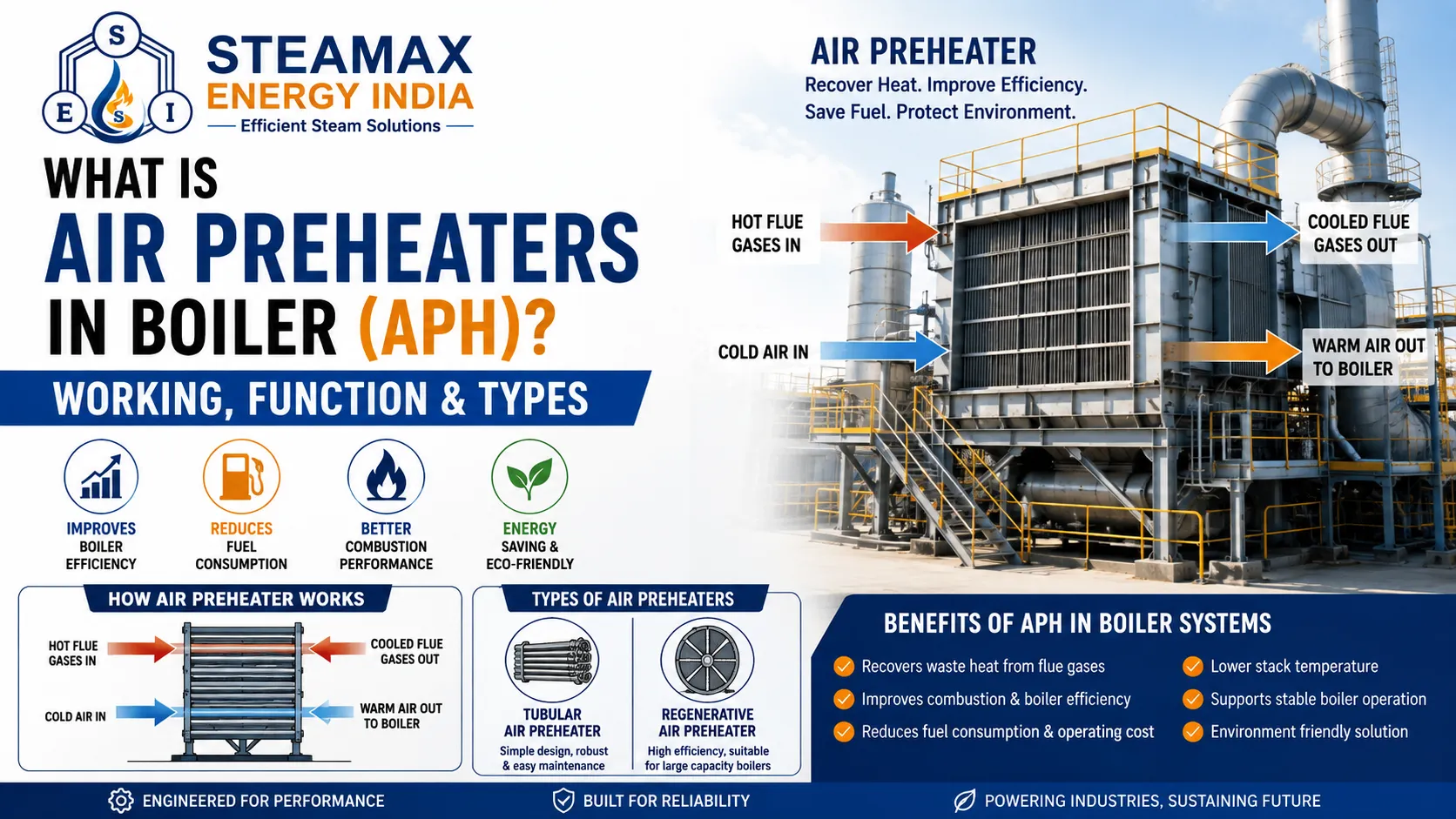
In a steam boiler, improving fuel efficiency is just as important as generating steam. A boiler loses a significant amount of heat through flue gases leaving the system. An air preheater is one of the important heat recovery components used to utilize part of this otherwise wasted heat. It transfers heat from hot flue gases to the incoming combustion air before that air enters the furnace.
This simple heat recovery process can improve combustion, reduce fuel consumption, and increase overall boiler efficiency. For industries operating boilers continuously, a properly selected air preheater in boiler systems can therefore make a meaningful difference to operating performance.
Steamax Energy India provides boiler and thermal energy solutions for industrial applications. In this guide, we will understand the APH full form in boiler, its working principle, functions, types, benefits, and important selection considerations.
What Is an Air Preheater in Boiler?
An air preheater is a heat exchanger installed in the flue-gas path of a boiler. Its main purpose is to preheat the combustion air using heat recovered from hot exhaust gases.
In a conventional boiler, combustion air enters the furnace at relatively low temperature. Meanwhile, the flue gases leaving the furnace contain considerable sensible heat. Instead of allowing all this heat to escape through the chimney, an air preheater transfers a portion of it to the incoming air.
The preheated air then enters the furnace at a higher temperature. This supports better combustion and helps the boiler extract more useful energy from the fuel.
APH Full Form in Boiler
The APH full form in boiler is Air Preheater. APH is commonly used as an abbreviation in boiler engineering, power plants, process industries, and thermal systems. Therefore, terms such as APH in boiler, air preheater, and air pre heater generally refer to the equipment used for recovering heat from boiler flue gases and transferring it to combustion air. Depending on the boiler design, an APH may be installed downstream of the economizer and upstream of the flue-gas cleaning equipment or chimney.
How Does an Air Preheater Work?
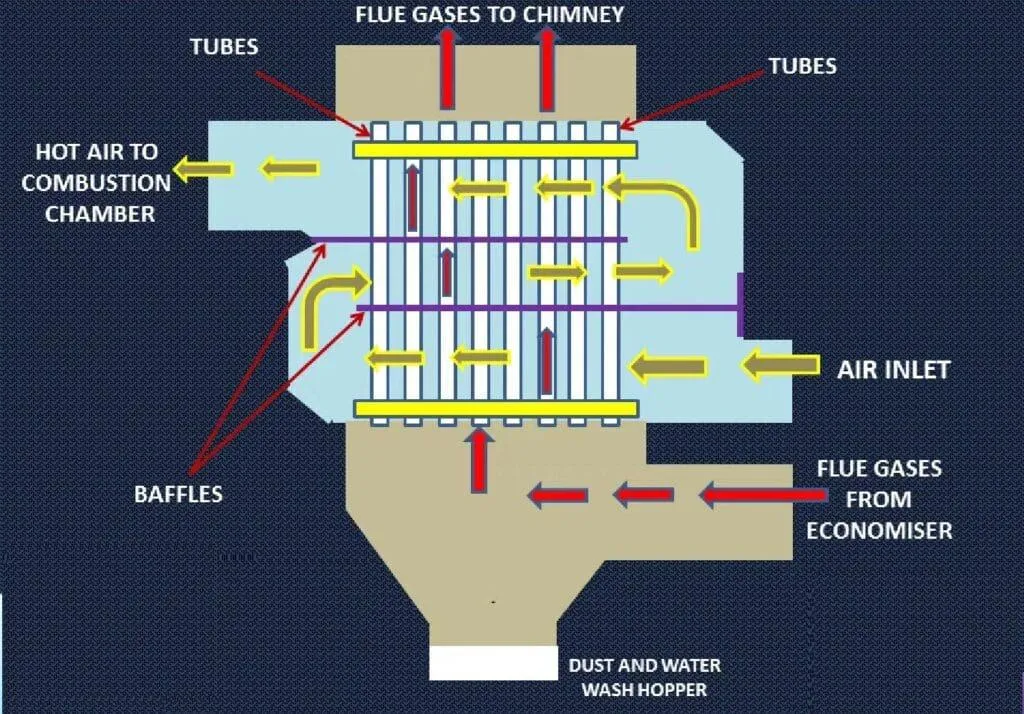
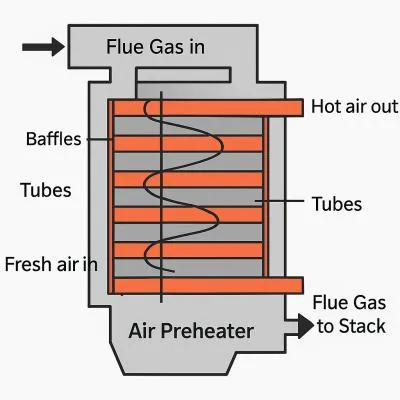
The working principle of an air preheater in boiler systems is based on heat transfer between hot flue gas and relatively cool combustion air. After combustion takes place inside the furnace, hot gases travel through the boiler’s heat-transfer surfaces. Before these gases are discharged through the stack, they pass through the air preheater.
At the same time, combustion air supplied by a forced-draft fan enters the air preheater. Heat from the hot flue gas is transferred to the incoming air.
The heated air is then supplied to the furnace, burner, or combustion zone. Because the air enters at a higher temperature, the fuel can burn more effectively under suitable operating conditions. The cooled flue gas continues toward the downstream equipment and ultimately exits through the chimney.
Main Functions of an Air Preheater
The primary function of an air preheater is heat recovery, but its effect on boiler operation extends beyond simply warming combustion air.
1. Recovers Waste Heat
Hot flue gases contain energy that would otherwise be lost through the stack. The air preheater recovers part of this heat and transfers it to the combustion air.
2. Improves Combustion
Preheated combustion air can support better fuel ignition and combustion. This can be particularly useful for solid fuels and other applications where combustion conditions need to be carefully controlled.
3. Improves Boiler Efficiency
By recovering heat from exhaust gases, the boiler can reduce the amount of additional fuel required to achieve the desired steam output. This can contribute to improved thermal efficiency.
4. Reduces Fuel Consumption
Better utilization of recovered heat can reduce fuel consumption for a given steam-generation requirement, provided the system is properly designed and operated.
5. Supports Stable Furnace Operation
Preheated air can help maintain suitable furnace temperatures and combustion conditions. Stable combustion is important for maintaining consistent boiler performance.
Types of Air Preheaters
Air preheaters are generally classified according to their method of heat transfer. The two major categories are recuperative air preheaters and regenerative air preheaters.
Recuperative Air Preheater
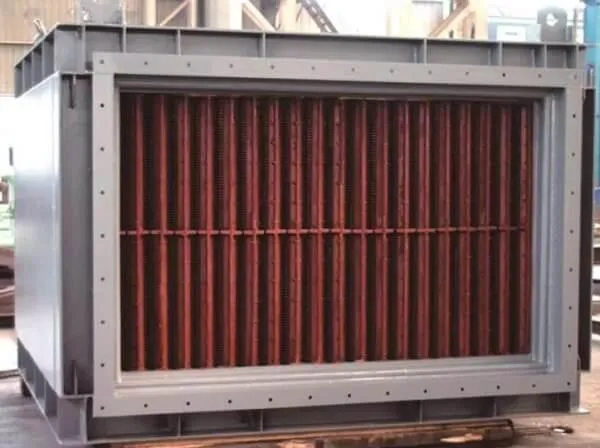
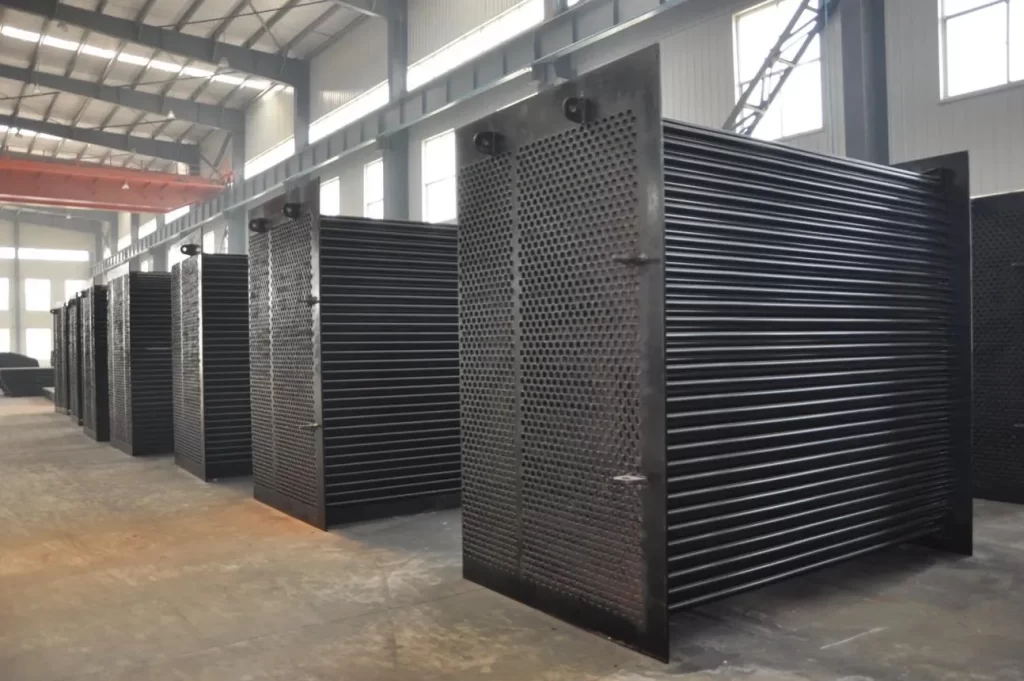
In a recuperative air preheater, heat is transferred continuously through a separating surface from the hot flue gas to the incoming air. Tubular air preheaters are a common example. Hot gases flow through tubes while air passes around the outside of the tubes, or the flow arrangement may be designed differently depending on the equipment.
Because the gas and air remain separated by the heat-transfer surface, the two streams do not normally come into direct contact. Recuperative systems can be suitable for various industrial boilers and heating applications depending on the required heat-transfer capacity and operating conditions.
Tubular Air Preheater
A tubular air preheater consists of a collection of tubes through which one fluid flows while the other passes across the tube surfaces.
Its relatively straightforward construction can make it suitable for industrial boiler applications. The tube material and arrangement are selected according to temperature, pressure, corrosion, fouling, and fuel characteristics.
Regenerative Air Preheater
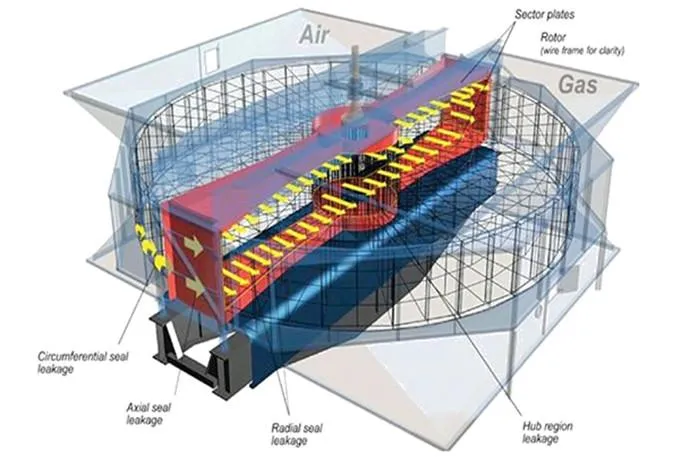
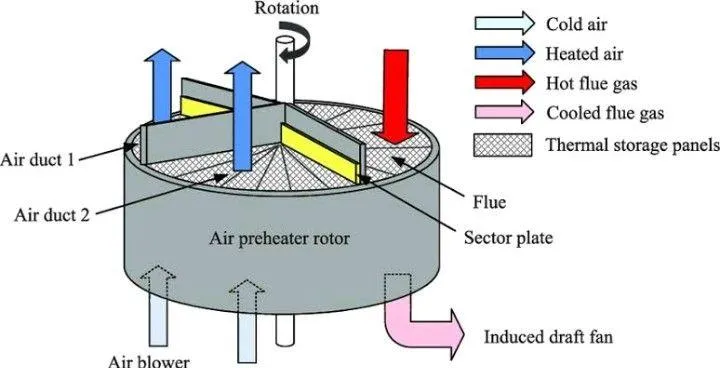
A regenerative air preheater works differently. Instead of transferring heat continuously through a fixed wall, a heat-storage element is alternately exposed to hot flue gas and combustion air.
During one part of the cycle, the heat-storage surface absorbs energy from the hot flue gas. During another part of the cycle, the stored heat is transferred to incoming combustion air.
Rotary regenerative air preheaters are commonly associated with large utility and industrial boiler installations where substantial heat recovery is required.
Air Pre Heater vs Economizer
An air pre heater and an economizer both recover heat from boiler flue gases, but they serve different purposes. An economizer transfers heat from flue gas to boiler feedwater. This raises the temperature of the water before it enters the boiler or steam-generation circuit.
An air preheater, on the other hand, transfers heat from flue gas to combustion air. Both components can work together in a boiler heat-recovery system. The arrangement and heat-transfer duty depend on the boiler design and operating conditions.
Benefits of Using APH in Boiler Systems
Installing an appropriately designed APH can provide several operational benefits:
- Better utilization of flue-gas heat.
- Improved combustion-air temperature.
- Potential improvement in boiler thermal efficiency.
- Reduced fuel requirement for the same useful heat output.
- Better combustion stability under suitable operating conditions.
- Lower stack heat losses.
- Improved overall energy utilization.
- Potential reduction in operating costs.
The actual savings depend on factors such as fuel type, boiler capacity, flue-gas temperature, combustion-air requirement, operating hours, and APH design.
Where Is an Air Preheater Used?
An air preheater can be used in different types of industrial and commercial boiler systems where sufficient flue-gas heat is available for recovery. Applications can include steam boilers, biomass-fired boilers, coal-fired systems, thermic fluid heating systems, process heating plants, and other combustion-based thermal systems.
Industries such as food processing, textiles, chemicals, pharmaceuticals, paper, rice mills, sugar processing, and manufacturing may use heat-recovery systems to improve overall energy utilization. The suitability of an APH depends on the boiler configuration and whether the recovered heat can be effectively transferred to the required combustion air.
Factors to Consider When Selecting an Air Preheater
Selecting an air preheater should be based on the complete boiler operating profile rather than capacity alone. Boiler capacity is an important starting point because the required combustion-air quantity and flue-gas flow depend on the boiler’s firing rate.
Fuel type also matters. Biomass, coal, oil, gas, and other fuels produce different flue-gas characteristics and may create different fouling or corrosion conditions.
Flue-gas temperature determines how much useful heat is available for recovery. The design must also avoid reducing the exhaust temperature excessively where this could create condensation or corrosion problems.
Pressure drop should also be considered. Excessive resistance on the air or gas side can increase fan power requirements and negatively affect overall efficiency.
Material selection, cleaning arrangements, maintenance accessibility, installation space, and expected operating hours should also be evaluated before finalizing the design.
Also Read: CFBC Boiler Explained: Working Principle, Diagram & Advantages
Maintenance of an Air Preheater
Regular maintenance is important for maintaining APH performance. Dust, ash, soot, and other deposits can accumulate on heat-transfer surfaces, particularly in solid-fuel-fired boilers.
If fouling becomes excessive, heat transfer may decrease and pressure drop may increase. Regular inspection and suitable cleaning practices can help maintain airflow and heat-transfer performance. Seals, bearings, tubes, structural components, and other parts should also be inspected according to the type of air preheater installed.
Why Choose Steamax Energy India?
Steamax Energy India provides industrial boiler and energy solutions designed around specific application requirements. The company understands that every boiler installation has different fuel, capacity, operating, and heat-recovery requirements.
For projects where an air preheater in boiler systems can improve heat recovery, the equipment can be selected according to boiler capacity, fuel characteristics, flue-gas conditions, combustion-air requirements, and available installation space.
A properly engineered APH can work as part of a broader boiler efficiency improvement strategy, alongside components such as economizers, burners, heat-recovery systems, and combustion controls.
Conclusion
An air preheater is an important boiler heat-recovery component that uses hot flue gases to preheat incoming combustion air. The APH full form in boiler is Air Preheater, and its main purpose is to recover waste heat that would otherwise leave the system through the stack.
By supplying warmer combustion air, APH in boiler systems can support better combustion, improve energy utilization, and potentially reduce fuel consumption. Tubular and other recuperative designs are commonly used for industrial applications, while regenerative systems are suitable for certain larger installations.
For industries operating steam boilers continuously, evaluating an air pre heater can be worthwhile when the available flue-gas heat and boiler configuration make heat recovery practical. Steamax Energy India can provide application-oriented boiler and energy solutions designed around the specific requirements of industrial users.