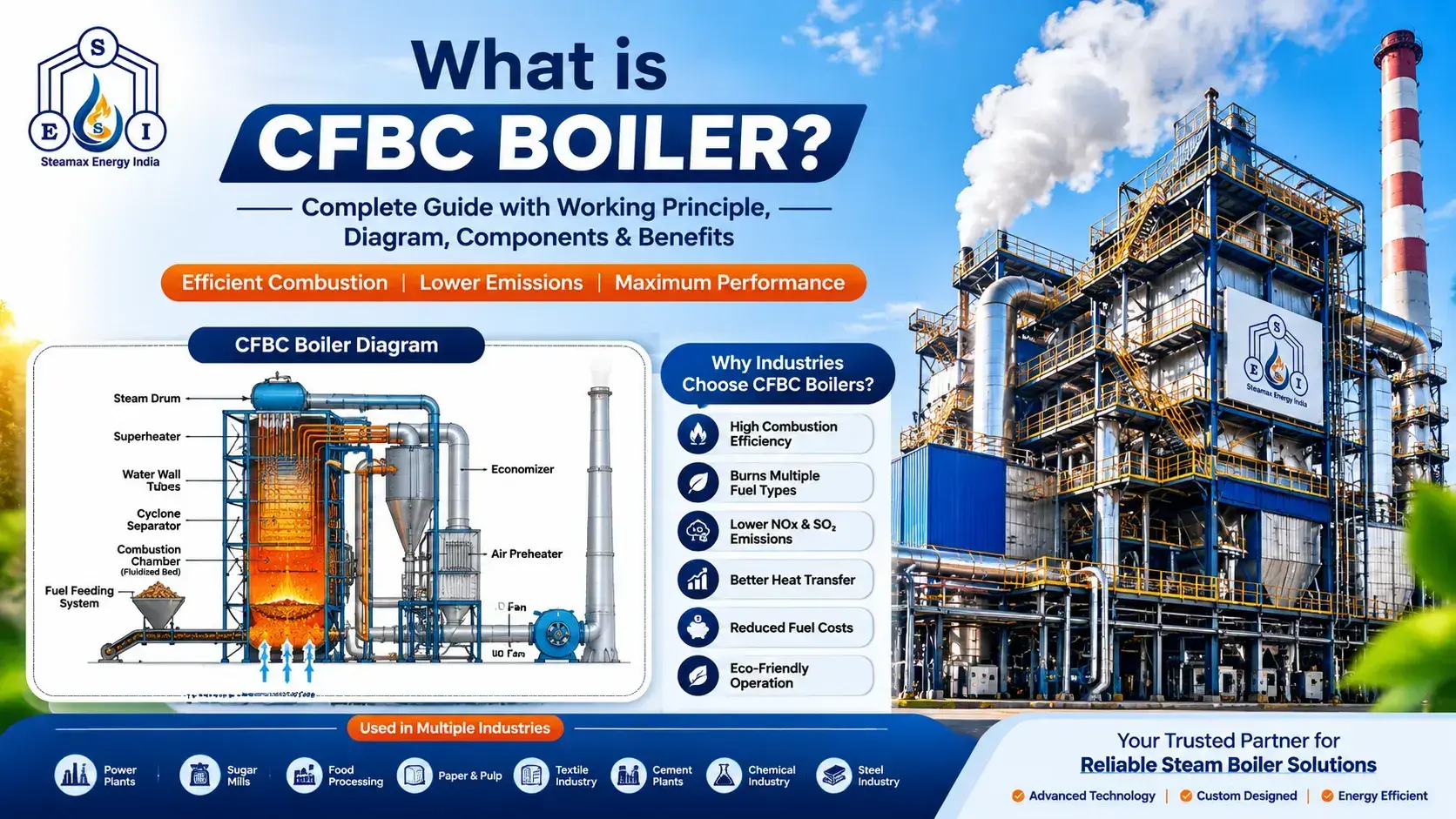
Industrial boilers play a vital role in power generation and process heating across multiple industries. As industries continue to focus on fuel efficiency, lower emissions, and cost-effective operations, advanced boiler technologies have become increasingly important. One of the most widely used technologies today is the CFBC boiler, known for its high combustion efficiency and ability to burn a wide range of fuels.
If you’ve ever wondered What is CFBC Boiler?, this comprehensive guide will explain the CFBC boiler full form, CFBC boiler working principle, major components, applications, benefits, and why it has become the preferred choice for many industries.
What is CFBC Boiler?
The CFBC boiler full form is Circulating Fluidized Bed Combustion Boiler.
A CFBC boiler is an advanced type of industrial steam boiler that burns fuel using a fluidized bed of solid particles suspended by high-velocity air. Unlike conventional boilers, where fuel burns on a grate, the CFBC boiler keeps fuel particles continuously circulating inside the combustion chamber, ensuring complete combustion and maximum heat transfer.
This unique combustion technology allows industries to burn coal, biomass, lignite, pet coke, agricultural waste, and other low-grade fuels with excellent efficiency while maintaining lower emissions.
Today, CFBC boilers are widely used in power plants, sugar mills, paper industries, textile units, food processing plants, cement factories, chemical industries, and many other industrial sectors.
Also Read: Industrial Steam Boilers in Food Processing: Benefits & Applications
CFBC Boiler Working Principle
Understanding the CFBC boiler working principle is relatively simple. The combustion chamber contains a bed of inert materials such as sand or ash. High-pressure air is blown upward through this bed, causing the particles to behave like a boiling liquid. This condition is called fluidization.
Fuel is continuously fed into the fluidized bed where it mixes thoroughly with the hot particles and combustion air. As combustion occurs, lightweight ash and partially burnt fuel particles are carried upward by the airflow.
Instead of escaping through the chimney, these particles are separated using cyclone separators and returned to the furnace for complete combustion. This continuous circulation improves fuel utilization and significantly increases boiler efficiency. The heat generated converts water inside the boiler tubes into high-pressure steam, which is then used for industrial heating or electricity generation.
CFBC Boiler Diagram
A typical CFBC boiler diagram includes the following major sections:
- Fuel Feeding System
- Fluidized Bed Combustion Chamber
- Air Distribution Nozzles
- Water Wall Tubes
- Superheater
- Economizer
- Cyclone Separator
- Particle Recirculation System
- Air Preheater
- Steam Drum
- Ash Handling System
- Chimney or Stack
A CFBC boiler diagram helps engineers understand how fuel circulates repeatedly within the furnace to maximize combustion efficiency while reducing emissions.
Main Components of a CFBC Boiler
Every CFBC boiler consists of several critical components that work together to ensure efficient steam generation.
Combustion Chamber
The combustion chamber is where fuel burns within the fluidized bed. It maintains uniform temperature distribution for stable combustion.
Air Distribution System
Specially designed nozzles supply primary air from beneath the bed, ensuring proper fluidization of fuel particles.
Cyclone Separator
One of the most important components, the cyclone separator captures partially burnt particles and sends them back into the furnace for complete combustion.
Steam Drum
The steam drum separates steam from water and supplies dry steam to the superheater.
Superheater
The superheater increases steam temperature, making it suitable for turbines and industrial process applications.
Economizer
The economizer utilizes waste heat from exhaust gases to preheat feed water, improving overall boiler efficiency.
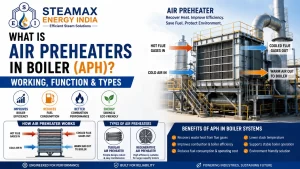
Air Preheater
The air preheater recovers heat from flue gases to warm incoming combustion air, reducing fuel consumption.
Advantages of CFBC Boiler
The popularity of CFBC boilers continues to grow because they offer several advantages over conventional steam boilers.
High Combustion Efficiency
The continuous circulation of fuel particles ensures complete combustion, reducing unburnt fuel losses and improving thermal efficiency.
Fuel Flexibility
A CFBC boiler can efficiently burn multiple fuel types, including low-grade coal, biomass, lignite, rice husk, bagasse, pet coke, and other industrial waste fuels.
Lower Emissions
CFBC technology naturally reduces NOx emissions because combustion occurs at lower temperatures. Limestone can also be added directly into the furnace to control SO₂ emissions.
Better Heat Transfer
The fluidized bed provides excellent contact between fuel and combustion air, resulting in uniform heat distribution and improved steam generation.
Reduced Fuel Costs
Since CFBC boilers can utilize inexpensive fuels, industries can significantly reduce operating expenses.
Stable Operation
Uniform furnace temperature minimizes thermal stress on boiler components and improves equipment reliability.
Applications of CFBC Boilers
Due to their versatility and fuel flexibility, CFBC boilers are used across numerous industries.
Some major applications include:
- Thermal Power Plants
- Sugar Mills
- Food Processing Industries
- Paper & Pulp Industries
- Textile Manufacturing
- Cement Plants
- Chemical Industries
- Steel Plants
- Fertilizer Plants
- Biomass Power Projects
- Distilleries
- Pharmaceutical Manufacturing
These industries require reliable steam generation while maintaining fuel efficiency and environmental compliance.
CFBC Boiler vs Conventional Boiler
When compared with conventional boilers, CFBC boilers offer several operational advantages. A conventional boiler generally burns fuel on fixed grates, resulting in uneven combustion and lower fuel utilization. It also has limited fuel flexibility and may produce higher emissions.
On the other hand, a CFBC boiler uses circulating fluidized bed combustion technology that ensures better mixing of fuel and air, higher combustion efficiency, lower emissions, and the ability to use various fuel types.
Although the initial investment for a CFBC boiler may be higher, its lower fuel consumption and reduced operating costs provide excellent long-term value.
Why Industries Prefer CFBC Boilers
Modern industries operate under increasing pressure to reduce production costs while meeting strict environmental regulations. CFBC boilers address both challenges by offering energy-efficient steam generation and lower emissions. Their ability to burn alternative fuels also reduces dependency on premium-grade coal, helping industries improve profitability without compromising performance.
Additionally, automated control systems, advanced combustion technology, and reliable operation make CFBC boilers an excellent choice for continuous industrial processes.
Why Choose Steamax Energy India?
At Steamax Energy India, we specialize in designing and manufacturing advanced industrial steam boiler solutions that deliver high efficiency, reliable performance, and long service life.
Our engineering expertise includes customized steam boilers, process heating solutions, energy-efficient combustion systems, and complete boiler installations for industries such as food processing, textiles, chemicals, pharmaceuticals, engineering, paper, sugar, and power generation.
Every boiler is manufactured using premium-quality materials, advanced engineering practices, and stringent quality standards to ensure maximum productivity and operational safety.
From consultation and system design to installation, commissioning, and after-sales support, our experienced professionals provide complete turnkey boiler solutions tailored to your industrial requirements.
Conclusion
Understanding What is CFBC Boiler? is important for industries seeking efficient, economical, and environmentally friendly steam generation solutions.
The CFBC boiler full form—Circulating Fluidized Bed Combustion Boiler—reflects a technology designed to improve fuel combustion through continuous circulation of fuel particles. The CFBC boiler working principle enables higher thermal efficiency, lower emissions, greater fuel flexibility, and long-term cost savings.
Whether you’re operating a power plant, food processing facility, textile mill, sugar factory, or chemical plant, investing in a modern CFBC boiler can significantly improve operational efficiency and sustainability.
If you’re looking for reliable industrial boiler solutions, Steamax Energy India offers advanced steam generation systems engineered to meet the highest standards of performance, safety, and energy efficiency.
Frequently Asked Questions (FAQs)
1. What is the CFBC boiler full form?
CFBC stands for Circulating Fluidized Bed Combustion Boiler, an advanced boiler technology that provides efficient fuel combustion and steam generation.
2. What is the CFBC boiler working principle?
A CFBC boiler works by circulating fuel particles within a fluidized bed using high-velocity air. Unburnt particles are separated and returned to the furnace for complete combustion.
3. What fuels can a CFBC boiler use?
CFBC boilers can burn coal, biomass, lignite, pet coke, rice husk, bagasse, agricultural waste, and several other solid fuels efficiently.
4. Where are CFBC boilers used?
They are widely used in power plants, sugar mills, food processing industries, paper mills, chemical plants, cement factories, textile industries, and steel manufacturing.
5. Does a CFBC boiler diagram help in understanding the system?
Yes. A CFBC boiler diagram clearly illustrates the arrangement of major components such as the combustion chamber, cyclone separator, steam drum, economizer, and air preheater, making the boiler’s operation easier to understand.