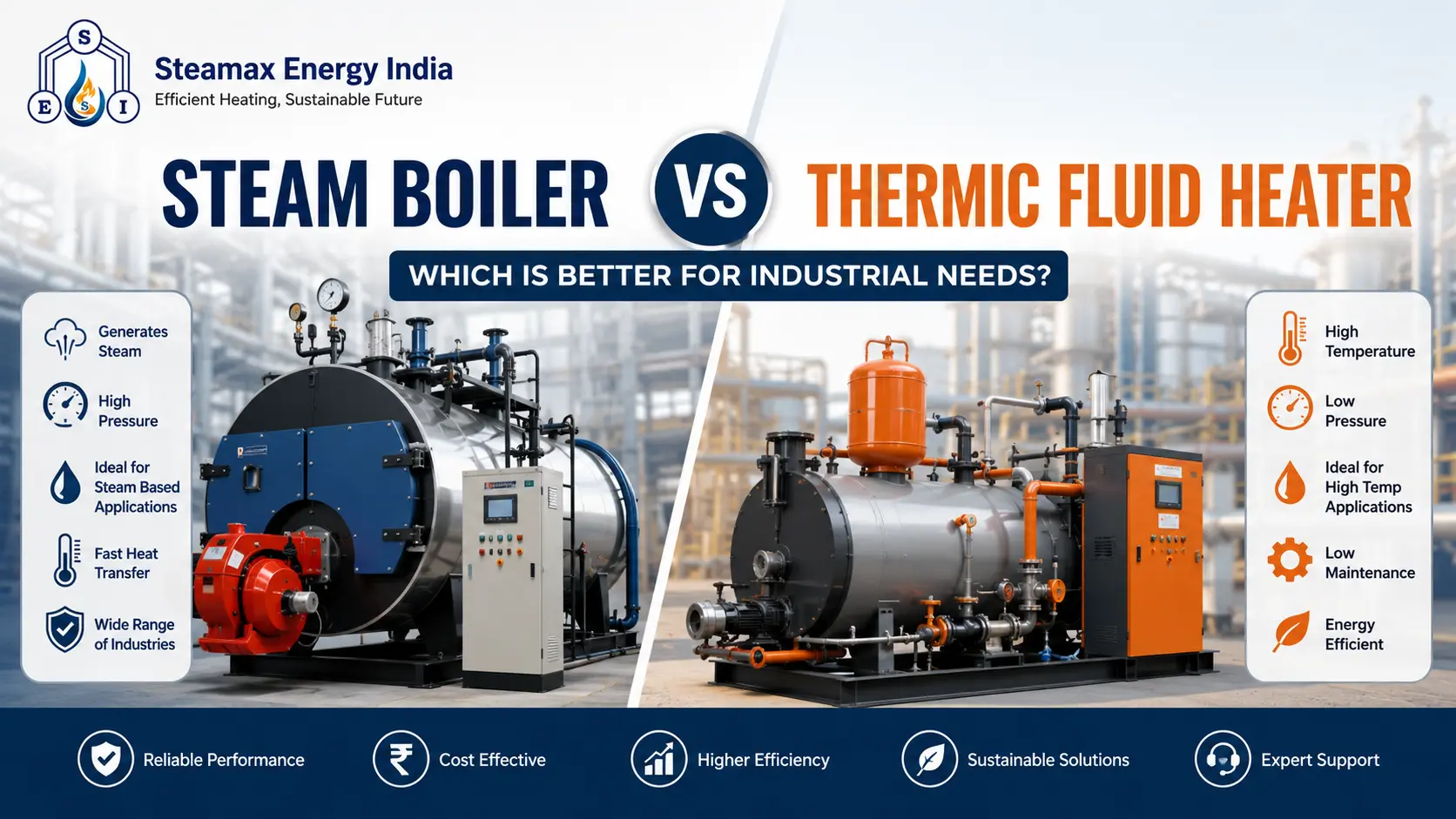
Selecting the right heating system is one of the most important decisions for any manufacturing facility. Whether you operate in the food processing, pharmaceutical, textile, chemical, paper, or packaging industry, your heating equipment directly impacts production efficiency, operating costs, product quality, and overall plant performance. Two of the most commonly used industrial heating systems are the Steam Boiler and the Thermic Fluid Heater. While both are designed to provide heat for industrial processes, they operate differently and are suitable for different applications.
So, Steam Boiler vs Thermic Fluid Heater: Which is better for industrial needs? The answer depends on factors such as your required operating temperature, process type, maintenance expectations, energy consumption, and long-term operating costs. In this blog, we’ll compare both systems in detail to help you choose the right solution for your business.
What is a Steam Boiler?
A Steam Boiler is a closed vessel that heats water to produce steam under controlled pressure. The generated steam is distributed through pipelines and used for heating, sterilization, drying, cooking, humidification, and various industrial manufacturing processes. Steam boilers are widely used because steam transfers heat quickly and efficiently, making it suitable for industries that require both heat and moisture.
Modern steam boilers are available in different fuel options, including oil-fired, gas-fired, electric, biomass, and solid fuel models, allowing industries to choose a system based on fuel availability and operating requirements.
What is a Thermic Fluid Heater?
A Thermic Fluid Heater uses specially formulated heat transfer oil instead of water. The thermal oil circulates through a closed-loop piping system, delivering heat to different process equipment without generating steam. Since the oil remains in a liquid state even at very high temperatures, thermic fluid heaters can provide temperatures above 300°C while operating at relatively low pressure.
These systems are commonly preferred for industries that require precise and continuous high-temperature heating without direct steam generation.
Steam Boiler vs Thermic Fluid Heater: Major Differences
| Feature | Steam Boiler | Thermic Fluid Heater |
|---|---|---|
| Heating Medium | Water & Steam | Heat Transfer Oil |
| Operating Pressure | Medium to High | Low Pressure |
| Maximum Temperature | Around 180°C–220°C (typical industrial applications) | Up to 350°C |
| Heat Transfer | Steam | Thermal Oil |
| Moisture Generation | Yes | No |
| Warm-Up Time | Faster | Moderate |
| Water Treatment | Required | Not Required |
| Ideal Applications | Steam-based processes | High-temperature heating |
Advantages of a Steam Boiler
Steam boilers remain the preferred choice for many industries because of their versatility and efficient heat transfer.
Fast Heat Transfer
Steam carries a large amount of heat energy, allowing products and equipment to reach the desired temperature quickly.
Suitable for Moisture-Based Processes
Industries such as food processing, dairy, pharmaceuticals, and hospitals require steam for sterilization, cooking, and cleaning applications.
Easy Steam Distribution
Steam can be transported over long distances through insulated pipelines with minimal heat loss when the system is properly designed.
Multiple Fuel Options
Modern steam boilers are available in gas-fired, oil-fired, electric, biomass, and solid fuel configurations.
Reliable Industrial Performance
Steam boilers are suitable for continuous production and can efficiently handle fluctuating process loads.
Advantages of a Thermic Fluid Heater
Thermic fluid heaters are designed for industries requiring high-temperature heating without the complications associated with high-pressure steam systems.
High Temperature at Low Pressure
Thermal oil can safely achieve temperatures above 300°C while operating at comparatively low pressure.
No Water Treatment
Unlike steam boilers, thermic fluid heaters do not require water softening or chemical treatment systems.
Lower Corrosion Risk
Since water is not used as the heating medium, corrosion, scaling, and rust-related issues are significantly reduced.
Uniform Heat Distribution
Thermal oil provides stable and consistent temperatures, making it ideal for precision manufacturing processes.
Lower Maintenance
The absence of steam traps, condensate systems, and water treatment equipment reduces maintenance requirements.
When Should You Choose a Steam Boiler?
A steam boiler is the better option if your industry requires:
- Sterilization processes
- Steam cooking
- Humidification
- Steam cleaning
- Textile processing
- Pharmaceutical manufacturing
- Food and beverage production
- Paper manufacturing
- Hospitals and healthcare facilities
- Chemical processing using steam
If your production process depends on steam itself rather than just heat, a steam boiler is generally the most suitable choice.
When Should You Choose a Thermic Fluid Heater?
A thermic fluid heater is more suitable when your application requires:
- High-temperature heating above 250°C
- Asphalt plants
- Chemical reactors
- Resin manufacturing
- Bitumen heating
- Paint and coating industries
- Lamination plants
- Rubber processing
- Plastic manufacturing
- Continuous indirect heating
These industries primarily require stable heat rather than steam.
Factors to Consider Before Choosing
Before investing in industrial heating equipment, consider the following factors:
Process Requirement
Determine whether your application requires steam or only high-temperature heat.
Operating Temperature
For temperatures above 250–300°C, thermic fluid heaters are generally more practical.
Initial Investment
Evaluate equipment cost, installation requirements, and supporting infrastructure.
Operating Cost
Compare fuel consumption, maintenance expenses, water treatment costs, and long-term efficiency.
Maintenance
Steam boilers require periodic inspection, water treatment, blowdown management, and steam trap maintenance. Thermic fluid heaters generally have fewer auxiliary systems.
Safety
Choose equipment that complies with industrial safety standards and is suitable for your operating environment.
Which Industries Use Steam Boilers?
Steam boilers are widely used in:
- Food Processing Plants
- Pharmaceutical Industry
- Textile Manufacturing
- Breweries
- Sugar Mills
- Paper Industry
- Hospitals
- Chemical Plants
- Dairy Industry
- Hotels and Commercial Kitchens
Which Industries Use Thermic Fluid Heaters?
Thermic fluid heaters are commonly used in:
- Chemical Industry
- Plastic Processing
- Rubber Industry
- Asphalt Plants
- Paint Manufacturing
- Lamination Industry
- Printing Industry
- Plywood Manufacturing
- Resin Plants
- Bitumen Heating Systems
Steam Boiler vs Thermic Fluid Heater: Which One is Better?
There is no universal answer because both systems serve different industrial purposes. Choose a Steam Boiler if your manufacturing process requires steam for heating, sterilization, humidification, or cleaning. It offers rapid heat transfer and is ideal for industries where steam is an essential part of production.
Choose a Thermic Fluid Heater if your process requires consistent high-temperature heating without steam. It operates at lower pressure, minimizes water-related maintenance, and provides excellent temperature stability for indirect heating applications.
The right solution ultimately depends on your process requirements, production capacity, energy efficiency goals, and long-term operating costs.
Why Choose Steamax Energy India?
Steamax Energy India is a trusted manufacturer of advanced industrial heating systems, delivering high-performance Steam Boilers and Thermic Fluid Heaters for diverse industrial applications. Our solutions are engineered for energy efficiency, reliable operation, low emissions, and long service life. From system selection and customization to installation and after-sales support, our experienced team helps businesses choose the most suitable heating equipment based on their operational requirements and production goals.
Conclusion
Understanding the differences between a Steam Boiler and a Thermic Fluid Heater is essential before making an investment. While steam boilers are ideal for applications requiring steam generation, thermic fluid heaters excel in delivering high-temperature indirect heating with lower operating pressure. Evaluating your industry’s heating needs, operating temperature, maintenance expectations, and production process will help you select the right equipment. Choosing the appropriate industrial heating solution not only improves productivity but also reduces operating costs and enhances long-term process efficiency.